







How to locate and label phone sockets
Phone sockets are easy to overlook until you need to move a broadband router, diagnose a dead extension, or prepare a room for renovation. Locating and labelling each socket gives you a clearer picture of your home’s telephone wiring, reduces confusion during fault finding, and helps you avoid disconnecting the wrong cable. With a simple inspection and a consistent labelling method, you can create a useful record for future work.
Start by identifying the main telephone entry point
Most homes have a primary telephone socket near the point where the external telecoms cable enters the building. This may be located in a hallway, living room, utility room, under the stairs, or near an older electrical consumer unit.
In UK properties, the main socket is often an NTE5 master socket. It commonly has a removable lower faceplate, sometimes marked with an Openreach logo. Behind this faceplate is a test socket, which allows you to check whether a fault lies in the provider’s incoming line or within your internal extension wiring.
Older installations can look different. You may find a fixed master socket with no removable section, a small junction box, or wiring that enters directly into an extension socket. If the layout is unclear, avoid pulling at cables or opening any components that appear to belong to the network provider.
Look for these signs when identifying the primary socket:
- A cable entering from an external wall, loft space, or underground duct
- A larger socket with a removable front section
- Markings such as “Master”, “Line”, “BT”, or “Openreach”
- Several internal cables leaving the rear or side of the socket
- A socket positioned close to where utility services enter the property
Check every room with a possible extension socket
Once you have found the likely master socket, inspect the rest of the property. Extension sockets may be installed in bedrooms, studies, kitchens, living rooms, and loft conversions. Older homes can also have sockets in less obvious locations, including cupboards, garages, or former home office spaces.
Telephone extension sockets are normally small white wall plates with a rectangular telephone outlet. Some have a standard UK BT-style connector, while others use an RJ11 connector for modern broadband equipment. You may also find unused faceplates that have been painted over or hidden behind furniture.
Take a notebook or use a notes app as you walk through the property. Record the room, wall position, socket type, and whether anything is connected. A description such as “Bedroom 2, north wall, beside radiator” is more useful than simply writing “bedroom socket”.
If your home has poor reception or a complicated distribution setup, your telephone and television cabling may be routed through similar areas. The practical advice in Freeview or Freesat in weak signal areas can also help you think more clearly about cable routes, wall positions, and signal equipment around the home.
Test which sockets are live before assigning labels
A socket may look connected while no longer being active. Testing each one prevents inaccurate labels and can reveal disconnected extensions.
The simplest method is to plug in a corded telephone and listen for a dial tone. If you have an active landline service, test each socket in turn. For broadband-only services, you may need to connect your router or use the provider’s recommended voice equipment.
Where an NTE5 master socket is fitted, remove the lower faceplate carefully and test the hidden socket behind it. If there is a working service at the test socket but not at your extension sockets, the issue is likely within your internal wiring or extension faceplates.
Use clear status notes, such as:
- Live, dial tone present
- Live, broadband in use
- No service detected
- Physically present, not tested
- Disconnected or suspected redundant
Do not use sharp objects in the socket contacts, and do not alter wiring connected to the provider’s network. If you need to work on extension cabling, disconnect broadband equipment first and photograph existing connections before changing anything.
Create labels that remain useful over time
A good label identifies both the socket and its role. Avoid labels such as “phone 1” unless you also keep a matching plan that explains where phone 1 is located.
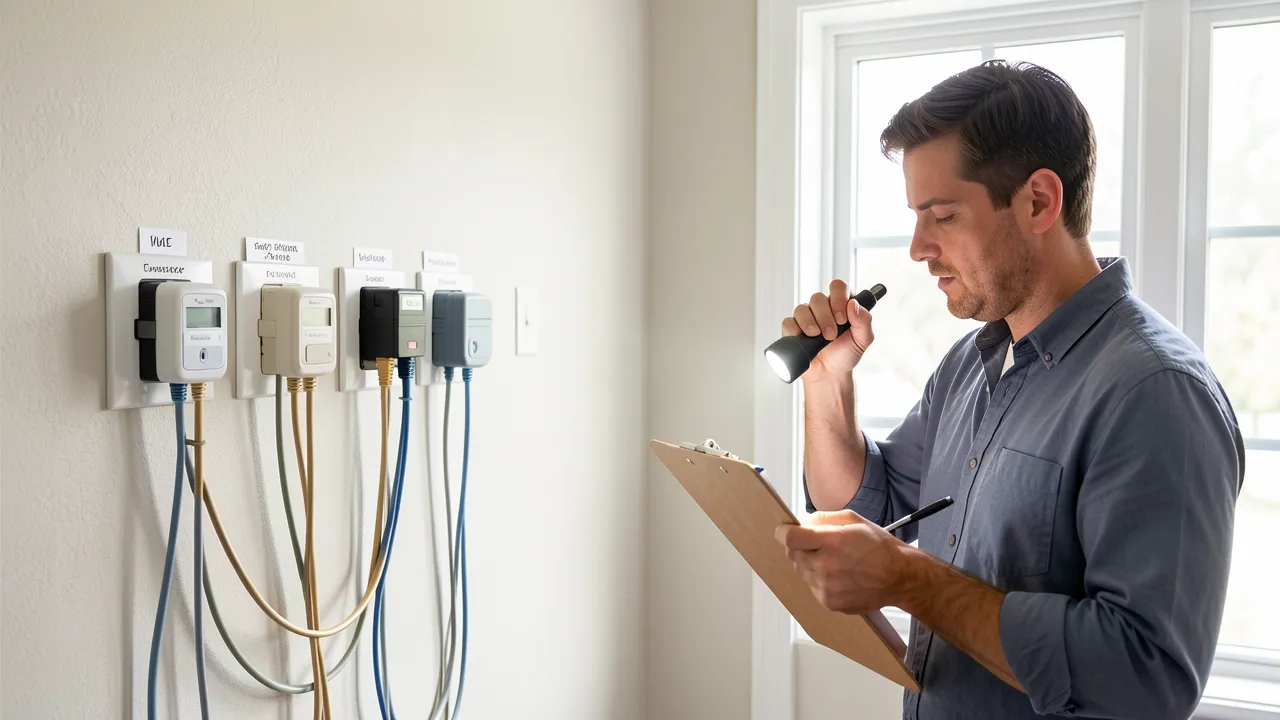
A practical format is: room name, socket number, and purpose. For example, “Study, TS-01, router” or “Bedroom 3, TS-04, spare”. If you have separate sockets for alarms, telecare equipment, fax machines, or broadband hardware, add this information to the label.
Use removable labels where possible. Small adhesive cable markers, label printer tape, or a neatly written sticker on the faceplate edge can work well. Do not cover socket openings, test ports, safety markings, or provider branding.
You may also want to create a simple floor plan. Mark each socket with its matching code and note the master socket location. Keep a printed copy near your home documents and a digital copy in a folder that household members can access.
Keep your telephone wiring record accurate
Telephone services are changing, with many homes moving from traditional copper landlines to digital voice services supplied through a broadband router. A socket that matters today may become redundant after an upgrade, while a router location may become far more significant.
Review your labels after major work, including redecorating, extension building, broadband changes, or electrical rewiring. Update the plan whenever a socket is removed, repurposed, or disconnected.
Before calling a telecoms engineer, having labelled sockets can save time. You can explain where the master socket is, which extensions have been tested, and where your router or digital phone equipment is installed.
Key points to retain:
- Find the master socket first, then trace likely extensions around the property.
- Test sockets rather than assuming every visible outlet is connected.
- Label sockets with a room, unique code, and intended use.
- Record inactive or redundant outlets as well as working ones.
- Keep a simple floor plan and update it after building or telecoms work.
A labelled socket plan makes future work simpler
Locating and labelling phone sockets is a modest task that can prevent unnecessary disruption later. Whether you are moving broadband equipment, investigating a fault, or planning a room refurbishment, a clear record of your telephone wiring gives you a more reliable starting point.